
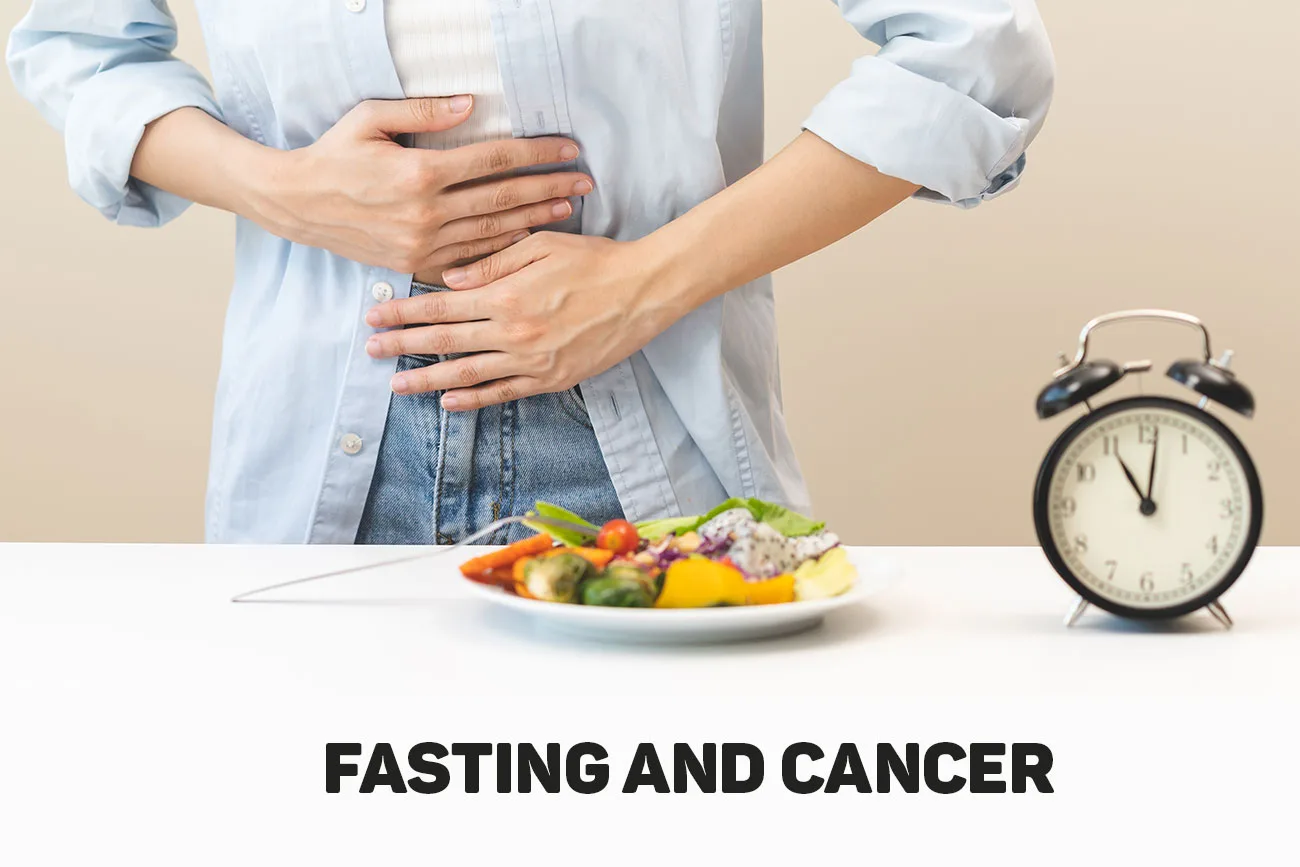
Back in 1982, a landmark paper reported that if you fed rats intermittently rather than having food available all the time they lived significantly longer [Goodrick]. Later, similar experiments confirmed this was not because food restriction meant they ate less so avoided obesity but there due to fundamental and favourable physiological changes occur in the body when we fast, such as reduces oxidative damage in cells [Mitchell]. In humans, intermittent fasting has been the focus of many religious practices for centuries and it is gaining popularity as a way to improve health, lose weight, help cognitive function, joint pains, reduce cholesterol, and even reverse type 2 diabetes and lower markers of chronic inflammation [Carter, Mitchell, Khanna, Cioffi]

Laboratory studies have shown that fasting helped lower the risk of certain obesity-related cancers, by helping participants to lose weight. If overweight people with cancer find intermittent fasting acceptable, then it may well be helpful. The physiological changes which occur with intermittent fasting (such as reduced oxidative stress and inflammation together with improved gut health) suggest there could be anti-cancer mechanisms, but human studies have not yet been forthcoming – mainly because they would be too difficult to design. In humans, the best evidence of sensible, effective fasting comes from a study that evaluated a large cohort of overweight women who had completed their initial cancer treatments. The researchers discovered that those who adopted early dinners and late breakfasts, leaving 13 hours between the meals (without intermediate snacking), lost significantly more weight, had lower levels of Hb A1c (a marker of glucose control over time) and lower inflammatory markers. What’s more, after five years, they had a 36% lower risk of breast cancer recurrence [Marinac].
Fasting Mimicking diets (FMD) – these combine, low calories (about 500 kal/day, low proteins, but higher fat and phytochemicals containing foods often combined with exercise. It is thought this tricks your body into entering a fasting state to trigger cellular cleanup (autophagy) and other metabolic benefits which are similar to water fasting (reduced circulating glucose, insulin and IGF-1 levels, reduction in the body’s stress resistance, reduce leptin, and an increase the expression of pro-apoptotic markers, while simultaneously reducing inflammatory mediators – Most experts believ that fasting mimicking one day a week is regarded as optimal for improving longevity.
Fasting and Chemotherapy – The benefits of fasting during chemotherapy are becoming clearer as more and more evidence is gained from clinical research … read more
In conclusion:
The emerging evidence for intermittent fasting is compelling but more robust research would help understand the exact mechanisms of benefit. Fasting should be avoided in people suffering from weight loss or cachexia. The most sustainable way of fasting, in the long term, is to extend the overnight fast to 13 hours. In the morning, if possible, going for a brisk walk before breakfast which will physiologically extend the fast. Then make sure the first meal has not processed sugar.
References
Goodrick C et al (1982). Effects of intermittent feeding upon growth and life span in rats. Gerontology, 28 (4), 233-41.
Mitchell S et al (2018). Daily fasting improves health and survival in male mice independent of diet composition and calories. Cell Metab. pii: S1550-4131(18), 30512-6.
Carter S et al (2018). Effect of intermittent compared with continuous energy restricted diet on glycemic control in patients with T2 diabetes: a RCT. JAMA Netw Open, 1 (3), e180756;
Cioffi I et al (2018). Intermittent versus continuous energy restriction on weight loss and cardiometabolic outcomes: a systematic review of RCTs. J Transl Med, 16 (1), 371; Meo S (2015). Physiological changes during fasting in Ramadan. J Pak Med Assoc, 65 (5,1),
Mosley M (2019). The Fast 800. Short books, ISBN 10987654321.
Carter S et al (2018). Effect of intermittent compared with continuous energy restricted diet on glycemic control in patients with T2 diabetes, a RCT. JAMA Netw Open, 1 (3), e180756;
Cioffi I et al (2018). Intermittent versus continuous energy restriction on weight loss and cardiometabolic outcomes: a systematic review of RCTs. J Transl Med, 16 (1), 371.
Peos J et al (2018). Continuous versus intermittent moderate energy restriction for fat mass loss and fat free mass in athletes: a RCT. BMJ Open Sport & Exercise Medicine, 4, e000423.
Phillips M (2019). Fasting as a therapy in neurological disease. Nutrients, 11 (10), 2501.
De Groot S et al (2015). The effects of short term fasting on tolerance to neoadjuvant chemotherapy: a randomized trial. Biomedical central (BMC), 15, 652;
Sun L et al (2017). Effect of fasting therapy in chemotherapy-protection and tumour suppression: a systematic review. Translational Cancer Research, 6 (2).
Caffa I et al (2015). Fasting potentiates the anticancer activity of tyrosine kinase by strengthening MAPK inhibition. Oncotarget, 6, (14).
Dorff T et al (2016). Safety and feasibility of fasting in combination with platinum-based chemotherapy. BMC Cancer. 2016, 16, 360.
Raffaghello L, et al Starvation-dependent differential stress resistance protects normal but not cancer cells against high-dose chemotherapy. Proc Natl Acad Sci U S A. 2008 17;105(24):8215-20. doi: 10.1073/pnas.0708100105.
Malinowski B et al (2019). Intermittent fasting in cardiovascular disorders-an overview. Nutrients, 11 (3), 673.
Khanna S et al (2017). Managing rheumatoid arthritis with dietary interventions. Front Nutr, 4, 52.
Marinac C et al (2016). Prolonged nightly fasting and breast cancer prognosis. JAMA Oncol, 2 (8), 1049-55.



Leave A Comment